Why Better Specs Don't Always Win: Mastering the Customer Battle
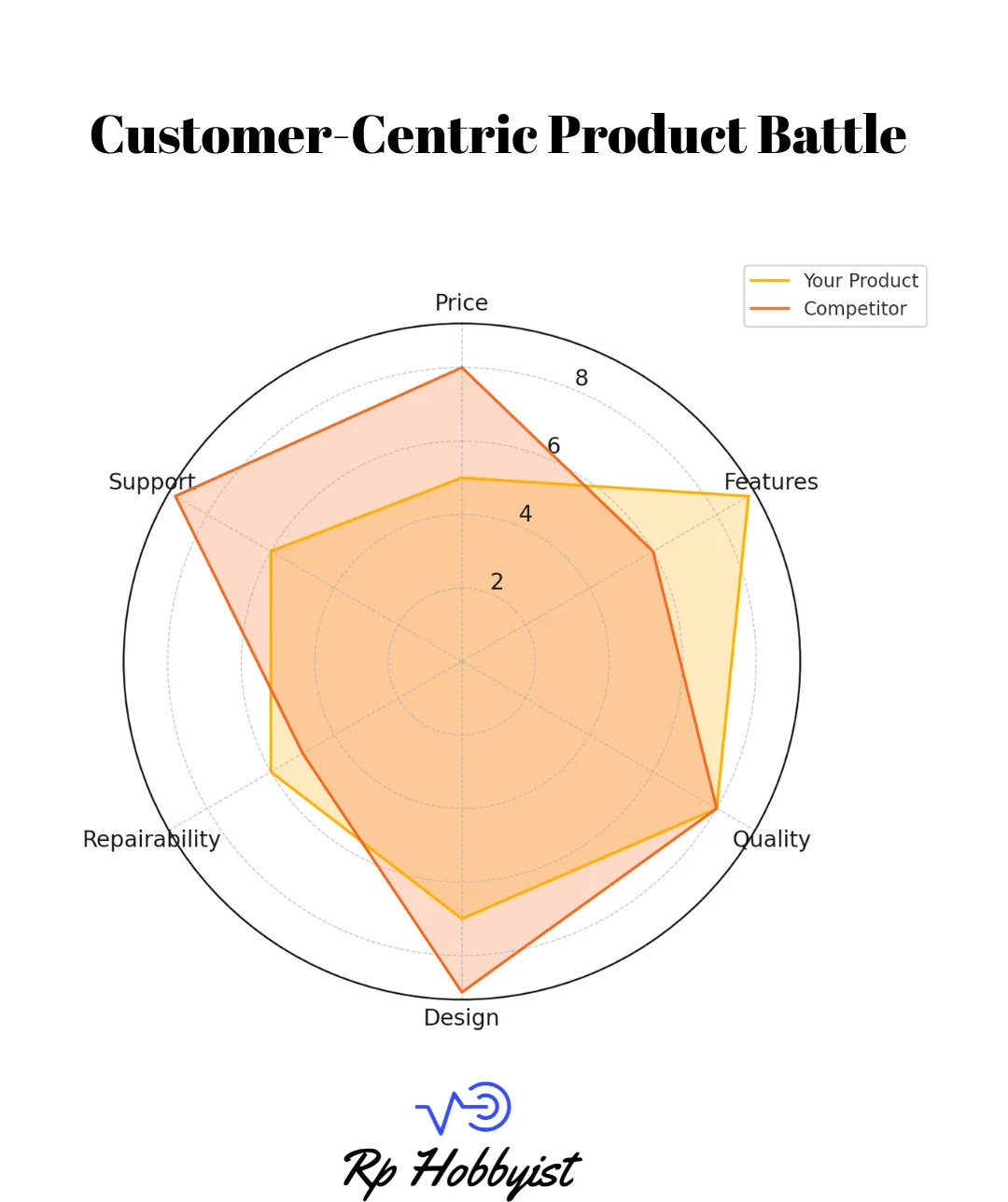
I've spent years in the "specs war." It's tempting to think that if your product has 10% better battery life or a faster processor, you'll win. But human-centric product design has shown me that customers don't buy specs - they buy trust.
Whenever I start a new project, like the DIY Bench Power Supply, I look at the competition through a very specific lens. Here are the 6 factors that actually matter when a user is deciding to click 'buy'.
1. The Affordability Filter
Price is the first gate. But notice I didn't say "cheapest." When I built my power supply, I knew I couldn't beat the \$30 mass-produced units from overseas on price. So I had to beat them on the next five points to justify the effort.
2. Solving the 1% Problem
Competitors often bloat their products with features nobody uses. I focused on the 1%: an integrated USB hub and custom RGB status lights. These aren't on every PSU, but for a hardware developer, they are lifesavers. Focus on the core problem, not the feature count.
3. The 'Day 100' Quality
Anyone can make a product look good on Day 1. Quality is about Day 100. Will the connectors stay tight? Will the 3D printed housing warp under heat? Building for longevity creates vocal advocates who do your marketing for you.
4. Frictionless Design
If your competitor's UI is a nightmare and yours is intuitive, you've already won. I spent hours refining the Motion Galaxy Lamp dial behavior to make it feel fluid. Design is how you handle your user's time.
5. The Right to Repair
This is huge for me. If my spool-speaker breaks, you can print a new part. By making products modular and repairable, you show respect for your customer's investment. In a world of planned obsolescence, repairability is a superpower.
6. The Safety Net
When things go wrong - and they will - how do you respond? I've found that being active in the maker community and providing open-source schematics builds a support network that no "corporate helpdesk" can match.
At the end of the day, your product isn't fighting a spec war. It's fighting a battle for your customer's attention and loyalty. Choose your battles wisely.
Frequently Asked Questions
Why do products with the best technical specs sometimes fail in the market?
Specs do not equal experience. A product with slightly lesser specs but flawless software, great reliability, and excellent customer support will consistently outsell a theoretically powerful machine that crashes frequently.
How do you identify what a hardware customer actually wants?
Stop looking at competitor spec sheets and start reading forums and support tickets. The features that actually drive sales are the ones that eliminate daily friction - like automated bed leveling in 3D printers, rather than minor speed bumps.
Is 'Day 100 Quality' more important than launch features?
Yes. Hardware degrades. A product that retains its precision, tactile feel, and battery life after 100 days of hard use creates brand advocates, which drives organic long-tail sales.
What is the 'feature fatigue' concept in product development?
Feature fatigue occurs when a product has too many complex features, overwhelming the user and degrading their overall experience, leading them to prefer simpler, more intuitive alternatives.
How do you measure customer-perceived quality?
Through user testing, net promoter scores (NPS), and analyzing customer support tickets. Perceived quality is determined by reliability, ease of use, and the emotional satisfaction of the overall customer journey.