The Developer’s Dilemma: Should You Focus on Process or Product?
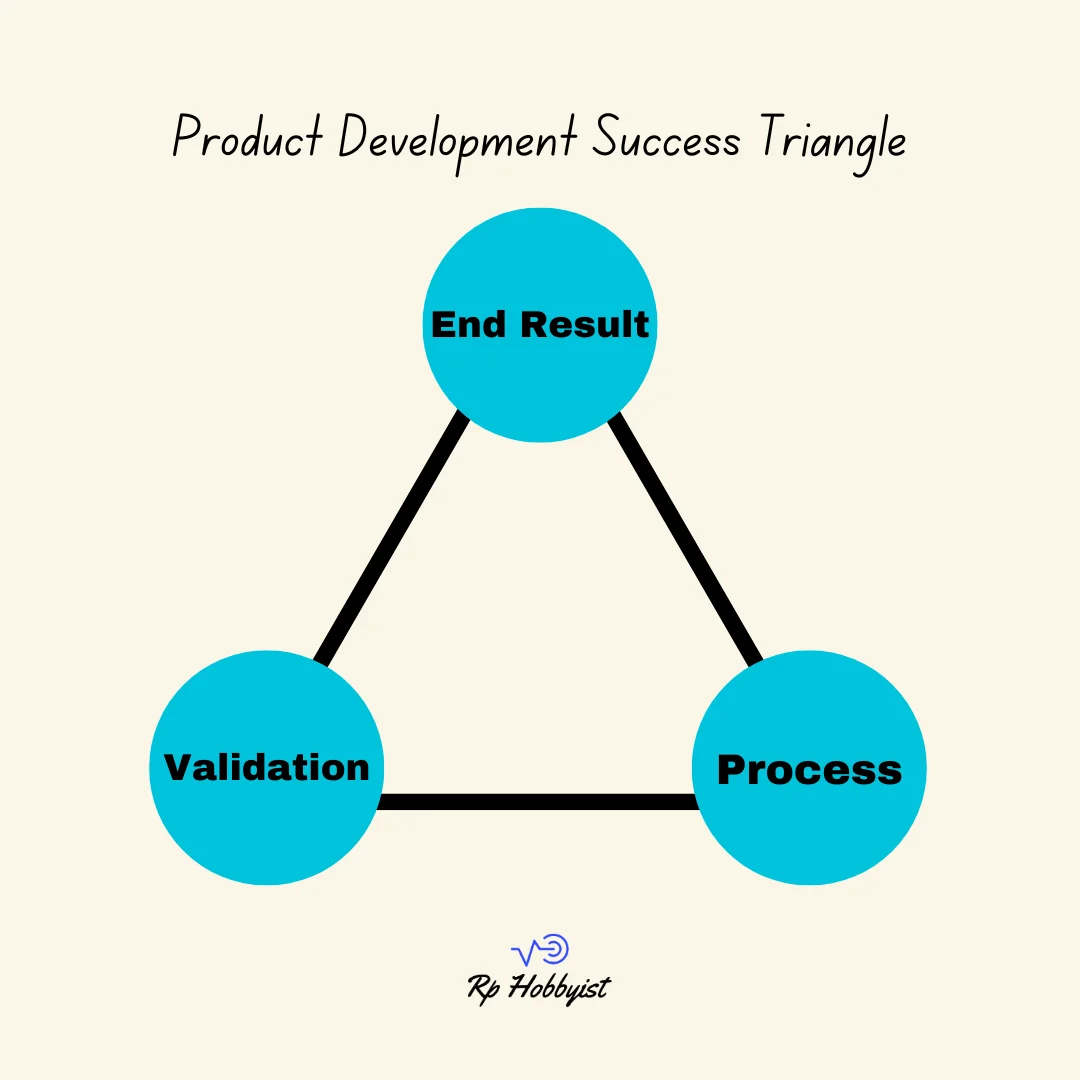
The Product Development Success Triangle
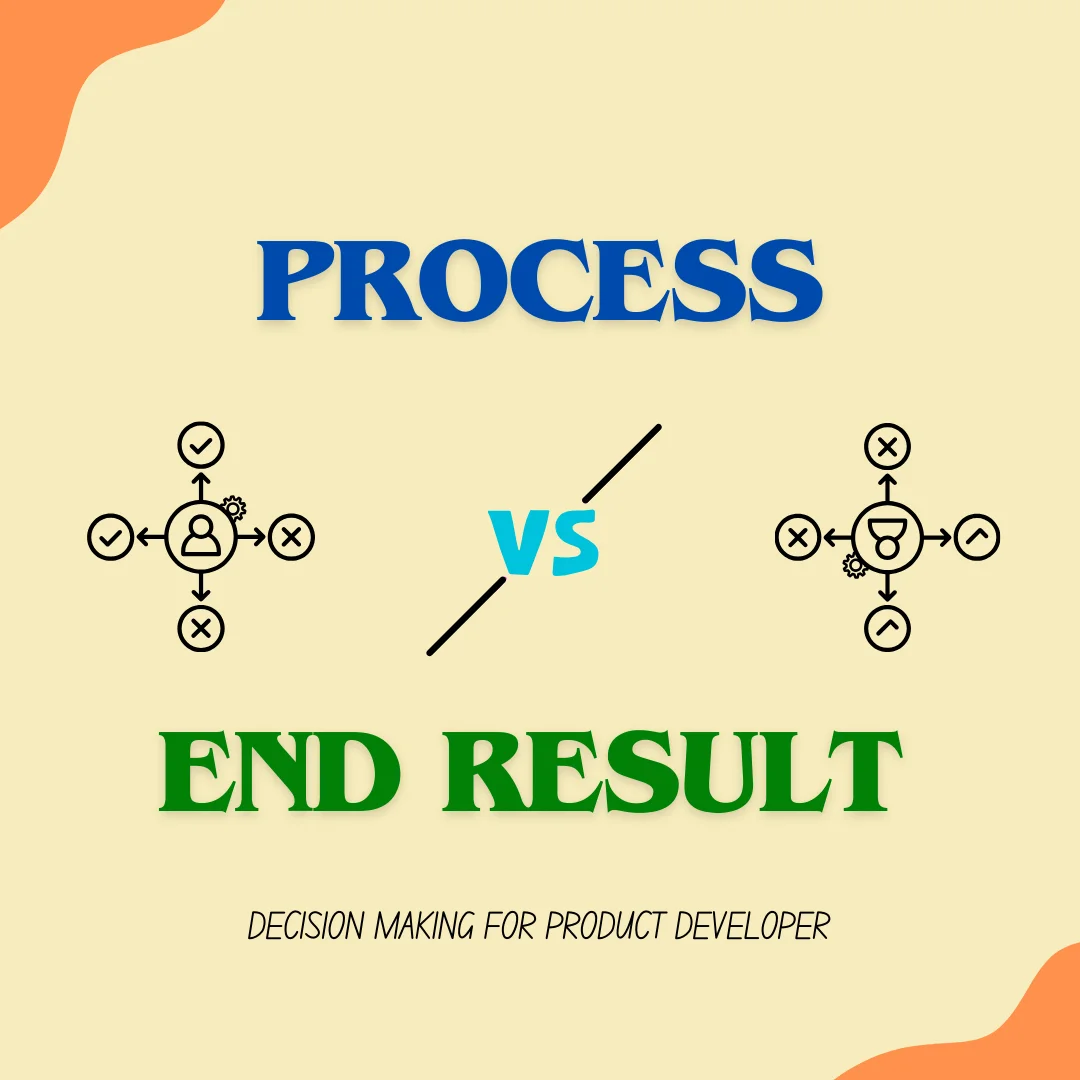
As product developers, we often find ourselves caught in a tug-of-war between two opposing forces: the drive for immediate results and the necessity of a rigorous process.
The Conflict: Velocity vs. Validity
On one side, we have the End Result Focus. This is the engine of momentum. It's great for prototyping, crisis-solving, and getting that initial "wow" factor to secure buy-in.
On the other side, we have the Process Focus. This ensures quality, scalability, and long-term success. It's the difference between a prototype that works once and a product that works a million times.
A Lesson from the Trenches: Battery Pack Development
In my experience developing battery packs, I've learned firsthand that knowing when to focus on the process and when to prioritize the end result is crucial.
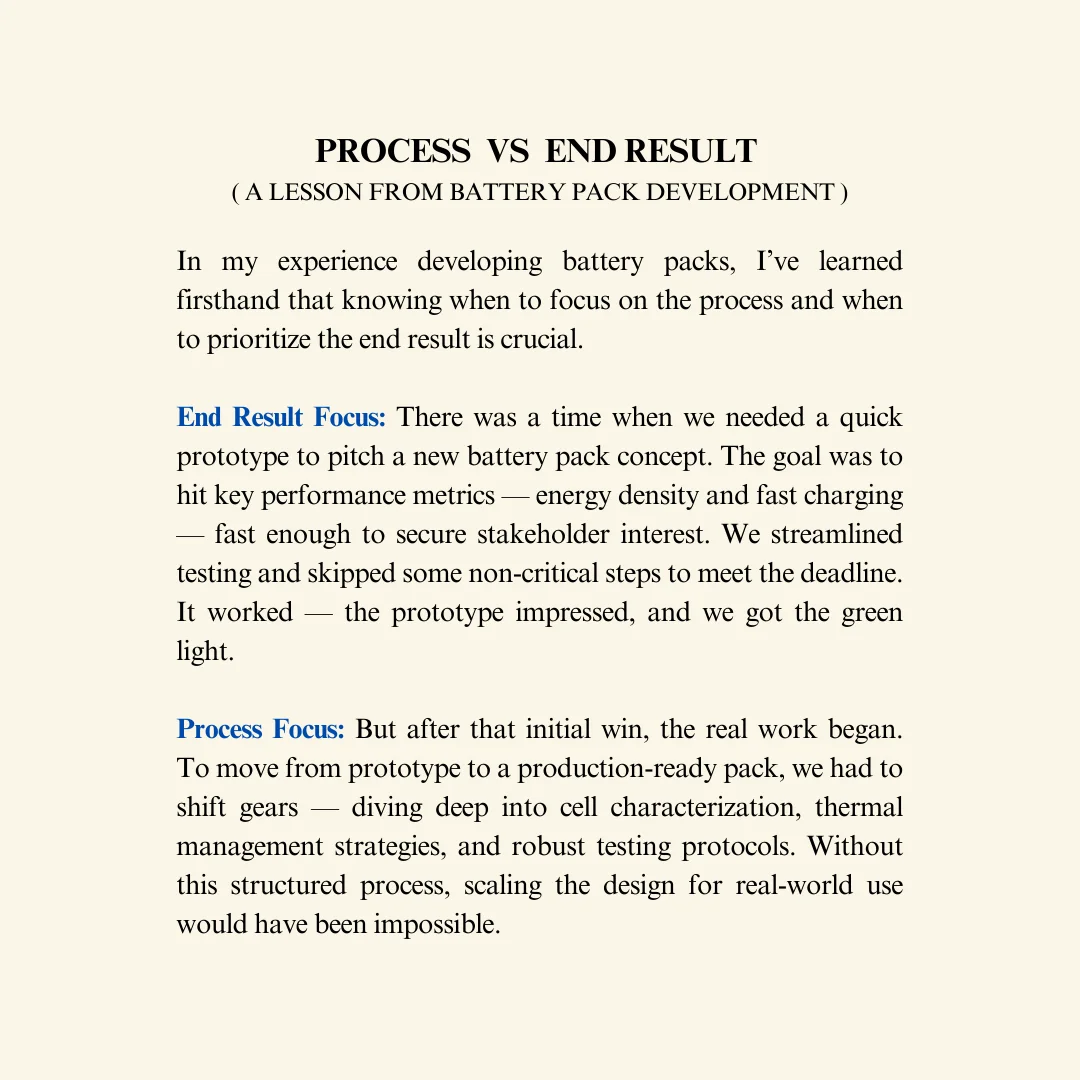
There was a time when we needed a quick prototype to pitch a new battery pack concept. The goal was to hit key performance metrics - energy density and fast charging - fast enough to secure stakeholder interest. We streamlined testing and skipped some non-critical steps to meet the deadline. It worked - the prototype impressed, and we got the green light.
But after that initial win, the real work began. To move from prototype to a production-ready pack, we had to shift gears - diving deep into cell characterization, thermal management strategies, and robust testing protocols. Without this structured process, scaling the design for real-world use would have been impossible.
Summary: It's All About Timing
Knowing when to sprint and when to pace yourself defines whether your product thrives or stumbles.
Frequently Asked Questions
Should I document my hardware development process?
Absolutely. The end product proves you built it, but the documentation of your process - the failed prototypes, the design changes - proves you understand *why* it works. This is invaluable for both open-source communities and future employers.
What is the 'developer's dilemma' in physical prototyping?
It's the friction between wanting a polished, final product immediately versus doing the slow, iterative testing required to ensure structural integrity and manufacturability.
How does rapid prototyping improve the final product?
By using cheap materials like cardboard or low-infill PLA early on, you can catch ergonomic and structural flaws fast. Failing fast locally saves massive tooling costs globally.
How do you define a Minimum Viable Product (MVP) in hardware development?
A hardware MVP is the simplest physical prototype that validates the core value proposition. It does not need injection-molded plastics or custom PCBs; it just needs to prove that the core technology solves the primary customer problem.
Why is agile development difficult for physical hardware compared to software?
Software has zero-cost deployment and near-instant iteration. Hardware involves physical lead times, tooling costs, and material supply chains. To apply agile to hardware, you must use modular architectures and 3D printing to de-risk assemblies early.